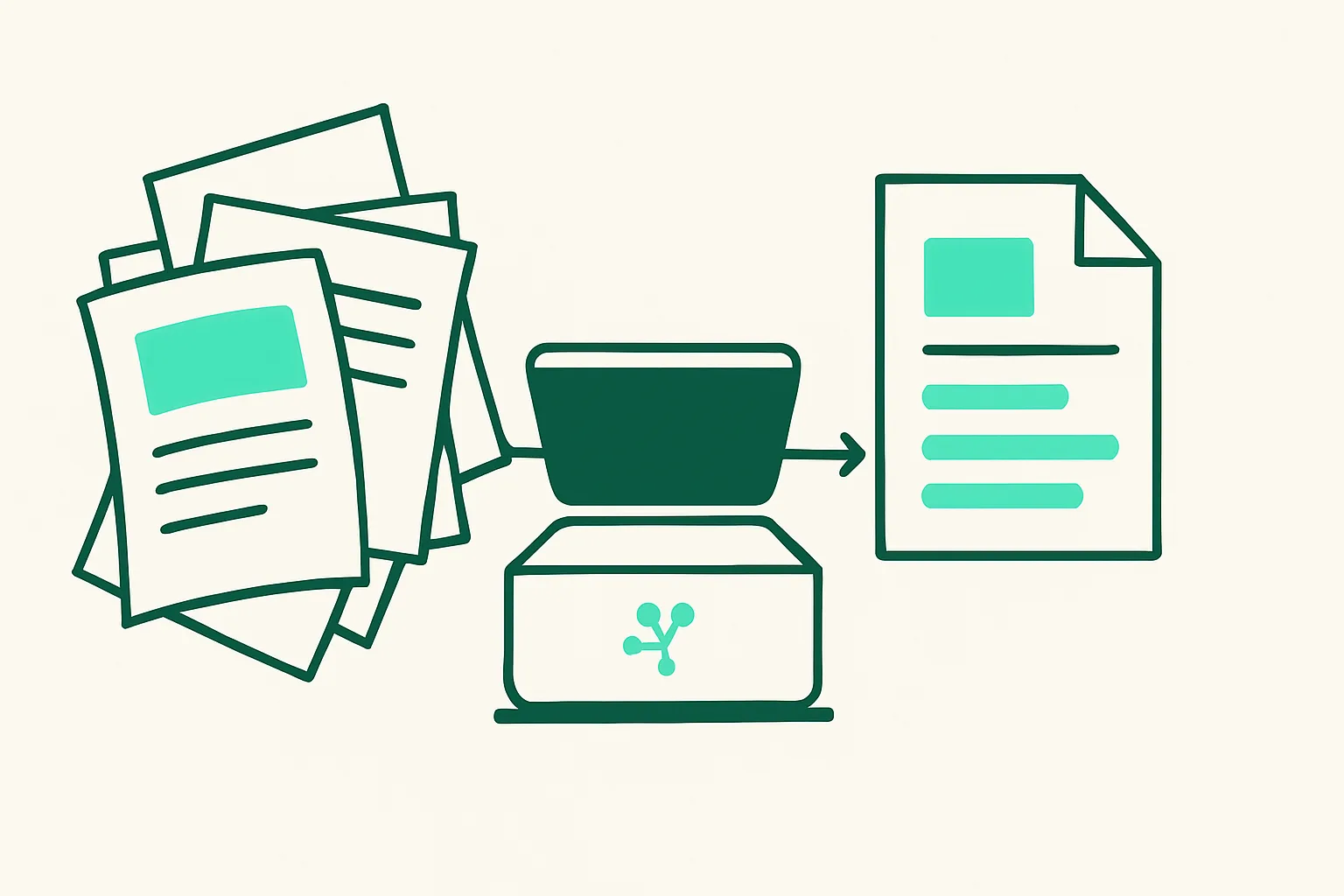
What Is Intelligent Document Processing (IDP)? Complete Guide
Every business runs on documents. Invoices, contracts, forms, reports — information flows through paper and PDFs. And in most companies, humans still do the tedious work of reading these documents and typing data into systems.
Intelligent Document Processing (IDP) changes this. Here's everything you need to know.
What Is Intelligent Document Processing?
Intelligent Document Processing (IDP) is the use of AI technologies to automatically extract, classify, validate, and route data from documents.
Unlike basic OCR (Optical Character Recognition) that just converts images to text, IDP understands documents:
- What the document is (invoice vs. contract vs. form)
- Where the important data is (even when layouts vary)
- What that data means (this is a total, that's a date, this is a vendor name)
- Whether the data makes sense (validation against business rules)
IDP vs. Traditional OCR
| Capability | Traditional OCR | Intelligent Document Processing | |------------|-----------------|--------------------------------| | Text extraction | Yes | Yes | | Understands document types | No | Yes | | Handles format variations | Limited | Yes | | Extracts structured data | Template-based | AI-based | | Validates data | No | Yes | | Learns over time | No | Yes | | Handles unstructured docs | No | Yes |
How Does IDP Work?
Modern IDP systems combine multiple AI technologies:
1. Document Classification
When a document arrives, AI determines what type it is. Invoice? Contract? Application form? This happens automatically, without human pre-sorting.
Technology: Machine learning classifiers trained on document examples
2. Intelligent Extraction
AI locates and extracts relevant data fields. Unlike template-based systems, IDP understands document semantics — it knows what an "invoice total" looks like even when different vendors use different formats.
Technology: Natural Language Processing (NLP) + Computer Vision + Large Language Models (LLMs)
3. Data Validation
Extracted data is checked against business rules. Does the math add up? Is this vendor in our system? Does this date make sense? Discrepancies are flagged for human review.
Technology: Rules engines + anomaly detection
4. Smart Routing
Documents and data flow to the right destination — a specific system, folder, or person — based on content and rules you define.
Technology: Workflow automation + integration APIs
5. Continuous Learning
The system improves over time. Corrections made by humans feed back into the model, increasing accuracy.
Technology: Machine learning with feedback loops
What Document Types Can IDP Handle?
IDP works with virtually any document type:
- Invoices and purchase orders
- Bank statements
- Financial statements
- Tax documents
Commercial Documents:
- Contracts and agreements
- Bills of lading
- Customs declarations
- Insurance policies and claims
Business Forms:
- Application forms
- Onboarding documents
- Survey responses
- Registration forms
Technical Documents:
- Verification reports
- Compliance certificates
- Inspection reports
- Technical specifications
What Results Can You Expect?
Based on real IDP implementations across industries:
| Metric | Typical Result | |--------|----------------| | Processing time | 80-95% reduction | | Extraction accuracy | 95-99%+ | | Human intervention | Reduced to 10-20% of documents | | Processing capacity | 5-10x increase | | Cost per document | 60-80% reduction |
Real-World Example
A carbon credit marketplace processing verification documents:
- Before IDP: 2-3 days per report, 3 FTEs dedicated to data entry
- After IDP: 10-15 minutes per report, 1 FTE for exception handling
- Result: 10x capacity increase, 99.2% accuracy, 3-month payback
Source: 41 Labs, 2026. Carbon credit marketplace processing verification documents — a roughly 99% drop in handling time per report.
When Does IDP Make Sense?
IDP delivers strong ROI when you have:
High Volume Processing 500+ documents per month where manual handling is a bottleneck.
Structured Data Needs Documents contain specific data fields that need to be extracted into your systems.
Multiple Document Types Various document formats from different sources (vendors, customers, partners).
Accuracy Requirements Data quality matters — errors cause downstream problems.
Scaling Constraints Growth requires more document processing capacity.
IDP Implementation: What to Expect
Timeline
| Phase | Duration | Activities | |-------|----------|------------| | Discovery | 1-2 weeks | Analyze document types, volumes, current process | | Design | 1-2 weeks | Architecture, integration planning, accuracy targets | | Build | 3-4 weeks | Model training, integration development, testing | | Pilot | 2 weeks | Production testing with real documents | | Deploy | 1 week | Go-live, monitoring, optimization |
Total: 8-12 weeks for a typical implementation
Investment
IDP project costs depend on complexity:
| Complexity | Typical Investment | Documents/Month | |------------|-------------------|-----------------| | Single document type | $25,000 - $50,000 | 500-2,000 | | Multiple document types | $50,000 - $100,000 | 2,000-10,000 | | Enterprise-wide | $100,000 - $200,000 | 10,000+ |
Plus ongoing costs:
- Cloud infrastructure: $500-2,000/month
- Maintenance and updates: 15-20% of project cost annually
IDP vs. Off-the-Shelf Document AI
You have two choices for IDP:
Off-the-Shelf Solutions
(Google Document AI, AWS Textract, Azure Document Intelligence)
Pros:
- Lower upfront cost
- Quick to start
- General-purpose extraction
Cons:
- Limited customization
- May not handle your specific document types
- Integration work still required
- Per-page pricing can be expensive at scale
Custom IDP
(Built specifically for your documents and processes)
Pros:
- Trained on your exact document types
- Integrates with your specific systems
- Accuracy optimized for your use case
- Fixed pricing at scale
Cons:
- Higher upfront investment
- Longer implementation timeline
Recommendation: Off-the-shelf works for simple, standard documents. Custom IDP is better for industry-specific documents, complex extraction requirements, or high volumes.
Common IDP Questions
How accurate is IDP really?
For well-structured documents (invoices, purchase orders), 99%+ accuracy is achievable. For semi-structured documents (contracts, reports), 95%+ is typical. The key is proper training on your specific document types.
What about handwritten documents?
Modern IDP can process handwritten text, though accuracy depends on legibility. For critical handwritten fields, systems flag low-confidence extractions for human review.
Does IDP work with multiple languages?
Yes. Modern IDP supports 100+ languages including all major Southeast Asian languages (Thai, Vietnamese, Bahasa Indonesia/Malaysia, Tagalog) plus Chinese, Japanese, Korean, and European languages.
How does IDP handle document variations?
This is where IDP differs from template-based systems. AI learns document semantics, not just layouts. It understands that "Total," "Grand Total," "Amount Due," and "Sum" all mean the same thing in an invoice context.
Is my document data secure?
IDP can be deployed within your infrastructure (on-premise or private cloud). Documents don't need to leave your environment. Choose a provider with appropriate security certifications for your industry.
Getting Started with IDP
Step 1: Audit Your Document Processes
Identify your highest-volume document workflows. Calculate:
- Documents processed per month
- Time spent per document
- Error rates and their costs
- People involved
Step 2: Prioritize by ROI
Focus on documents that are:
- High volume
- Time-consuming to process
- Error-prone when done manually
- Critical to business operations
Step 3: Evaluate Solutions
For each priority document type:
- Can off-the-shelf tools handle it?
- What accuracy is required?
- What systems need to receive the data?
- What's the expected ROI?
Step 4: Start with a Pilot
Don't try to automate everything at once. Pick one document type, prove the ROI, then expand.
Next Steps
If document processing is a bottleneck in your business, IDP can deliver significant ROI. The same extraction techniques also power AI quote automation, turning inbound requests into priced quotes in minutes. The key is choosing the right documents to automate and the right implementation approach.
41 Labs specializes in custom IDP solutions for businesses with complex document requirements. We offer a free discovery call to assess your document workflows and provide a realistic evaluation of what's possible.
41 Labs builds custom AI document processing systems for B2B companies across Southeast Asia. We specialize in high-accuracy extraction for complex, industry-specific documents.
Ready to Explore AI for Your Business?
Every business has operations that could run faster, cheaper, and more accurately with AI. The question is which ones — and whether the ROI justifies the investment. Book a free strategy call with 41 Labs. We will audit your current workflows and show you exactly where AI delivers the highest impact.