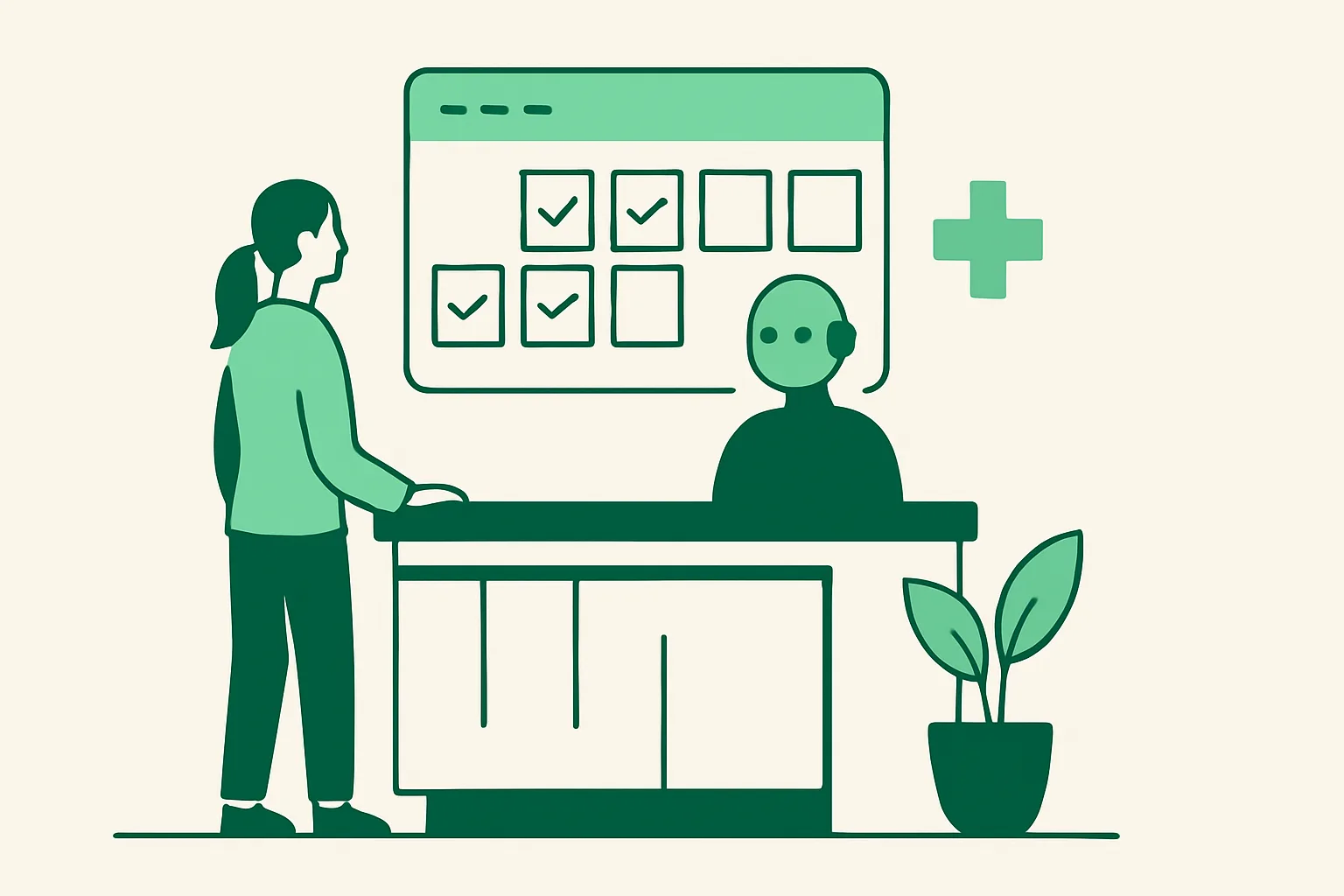
A GP clinic in Toa Payoh has two receptionists. One handles the queue — checking NRIC, pulling up patient records, processing MediSave claims. The other answers the phone, which rings 40-60 times a day. Half those calls are appointment bookings. A quarter are people asking "is the doctor in today?" or "do you accept CHAS?" The rest are follow-ups, referral queries, and medication refill requests.
When both receptionists are busy — which is most of the morning — calls go to voicemail. Patients hang up and try the clinic down the road. The clinic loses 8-12 potential appointments per day to missed calls. At an average consultation fee of $35-50 (before medication), that's $280-$600 in daily revenue walking out the door. Over a month, $8,000-$18,000 in missed revenue because nobody picked up the phone.
This is the reality for the majority of Singapore's 1,800+ GP clinics and the thousands of specialist and dental practices. And it's exactly the kind of problem that AI solves cleanly, affordably, and without disrupting clinical workflows.
1. The AI Receptionist: Never Miss Another Call
An AI phone agent for a clinic is not a clunky IVR menu ("Press 1 for appointments, press 2 for..."). It's a conversational voice agent that sounds natural, understands context, and handles the exact same tasks your receptionist does on the phone:
- Books appointments by checking real-time availability in your clinic management system (CMS), confirming the patient's preferred date and time, and sending a WhatsApp or SMS confirmation. This is the core of AI appointment booking — the patient never touches a portal
- Answers FAQs — clinic hours, doctor availability, accepted insurance panels (CHAS, MediSave, company panels), parking, directions
- Handles multilingual callers. Singapore is multilingual. Your patients speak English, Mandarin, Malay, and Tamil. AI voice agents now handle all four with native-quality fluency. No more losing elderly patients who can't navigate an English-only phone system.
- Escalates appropriately — medical emergencies get immediately routed to the clinic nurse or doctor. The AI knows the difference between "I need to see the doctor about my cough" and "I'm having chest pains right now."
The key advantage: this works 24/7. A patient wakes up at 2am with a rash and wants to book a morning appointment. They call, the AI picks up, books the 9:30am slot, sends a confirmation. When the receptionist arrives at 8:30am, the appointment is already in the system. No missed opportunity. No voicemail to return.
Platforms like 1UP Sales AI have already demonstrated the power of AI voice agents for handling inbound business calls in the Singapore market. For clinics, the use case is even more compelling because the conversation patterns are highly predictable — the same 15-20 questions account for 90% of all calls.
2. No-Shows: The Silent Profit Killer
No-show rates at Singapore GP clinics average 12-18%. Specialist clinics — where appointments are booked weeks in advance — see rates as high as 25-30%. A specialist clinic with 20 appointment slots per day losing 5 to no-shows is burning $250-$750 in revenue daily, plus the opportunity cost of patients who couldn't get those slots.
AI-powered reminder systems — similar to those used in restaurant no-show reduction — go far beyond a generic SMS blast:
- Smart timing: The AI learns which reminder timing works for different patient segments. Working adults respond best to reminders sent at 7pm the evening before. Elderly patients respond better to a morning reminder 2 hours before the appointment. The system adapts automatically — the same pattern that drives results in AI for salons and beauty in Singapore, where missed appointments hit margins just as hard.
- Two-way WhatsApp: Instead of a one-way SMS, the patient receives a WhatsApp message with a tap-to-confirm or tap-to-reschedule button. If they cancel, the AI immediately offers the next 3 available slots. If the slot opens up, the waitlisted patient gets notified instantly.
- Repeat offender flagging: The system identifies chronic no-show patients and can require advance confirmation or implement a deposit policy for those specific individuals — without penalising your reliable patients.
Clinics that implement AI-driven reminder sequences consistently report no-show reductions of 30-45%. For a specialist clinic, that translates to recovering 1.5-2.5 additional appointments per day — worth $3,000-$8,000 per month in recaptured revenue.
3. WhatsApp Automation: Meeting Patients Where They Are
WhatsApp is Singapore's dominant messaging platform — 4.5 million monthly active users in a country of 5.9 million. Your patients don't want to call. They want to text. But every WhatsApp message to your clinic requires a human to read, interpret, and respond. During busy periods, response times stretch to hours. Patients get frustrated and book elsewhere.
An AI WhatsApp agent — the same technology behind our WhatsApp AI chatbot service — handles the full patient communication workflow:
- Appointment booking via chat: "Hi, I'd like to see Dr Tan tomorrow morning." The AI checks availability, offers options, confirms the booking — all within the WhatsApp conversation. No app download, no portal login. This is exactly what 41 Closer, our fully managed WhatsApp AI sales agent, does for enquiries: it answers, qualifies, and books without a human touching the message.
- Pre-visit intake: Before the appointment, the AI sends a brief intake form via WhatsApp — current symptoms, allergies, medications, NRIC for registration. When the patient arrives, the receptionist already has everything. Registration takes 30 seconds instead of 5 minutes.
- Post-visit follow-up: Two days after the visit, the AI checks in: "How are you feeling after your visit? Any side effects from the medication?" This isn't just good patient care — it catches adverse reactions early and builds loyalty.
- Medication refill requests: For patients on chronic medications, the AI reminds them when their supply is running low and books a refill consultation. This is a revenue generator that most clinics miss entirely.
The multilingual capability is critical here. An elderly patient messages in Chinese: "我要预约明天看医生." The AI responds in Chinese, books the appointment, and sends a Chinese-language confirmation. No human translator needed.
4. Clinical Documentation: Giving Doctors Their Time Back
Every GP in Singapore spends 15-25% of their working day on documentation — typing consultation notes, filling out MC forms, writing referral letters, updating patient records. For a doctor seeing 40 patients a day, that's 1-2 minutes of documentation per patient, adding up to 40-80 minutes of admin work daily.
AI medical scribes are changing this. Medow Health, a Singapore-based startup, has built an AI scribe specifically for the local healthcare context — understanding Singlish speech patterns, local medication names, and MOH documentation requirements. AIGP Health made headlines as the first HSA-approved AI system for GP clinics, validating that regulatory bodies are ready for AI in clinical settings.
How it works in practice:
- The doctor conducts the consultation normally, speaking to the patient
- The AI listens (with patient consent), transcribes the conversation, and generates structured consultation notes in the required format
- The doctor reviews and approves the notes in 10-15 seconds instead of typing for 2 minutes
- MC forms, referral letters, and medication lists are auto-generated from the consultation data
The time savings are significant: doctors using AI scribes consistently report seeing 5-8 additional patients per day. At $40 per consultation, that's $200-$320 in additional daily revenue — or $4,000-$6,400 per month — from a tool that costs a fraction of that.
5. Compliance: AI That Keeps You on the Right Side of MOH
Singapore's healthcare regulatory environment is strict, and rightly so. The Personal Data Protection Act (PDPA), MOH's healthcare-specific data guidelines, and HSA's medical device regulations all create compliance obligations that clinics must navigate. Many clinic owners worry that AI means compliance risk. The reality is the opposite — properly implemented AI reduces compliance risk.
- Data handling: AI systems built for Singapore healthcare store patient data on Singapore-based servers (AWS ap-southeast-1 or local data centres), encrypt data at rest and in transit, and maintain audit trails that MOH requires. This is often more robust than the Excel spreadsheets and paper files many clinics still rely on.
- Consent management: The AI automatically records patient consent for data processing, sends privacy notices, and flags when consent needs renewal. No more paper consent forms that get lost in filing cabinets.
- Audit trails: Every AI interaction — every appointment booked, every reminder sent, every patient communication — is logged with timestamps. If MOH audits your clinic, you have a complete, searchable record.
- CHAS and MediSave compliance: The AI can verify patient eligibility for CHAS subsidies and MediSave claims at the point of booking, reducing claim rejections and administrative rework.
MIEA Health has been working on AI-powered clinical decision support tools designed specifically for the Singapore regulatory context, showing that the industry is moving toward AI systems that are built compliance-first rather than bolted on as an afterthought.
What This Costs — and the ROI Math
Let's run the numbers for a typical GP clinic with 2 doctors and 30-40 patients per day:
- AI phone + WhatsApp agent: $1,500-$3,000 to build, $200-$500/month to run. Recovers 8-12 missed-call appointments per day = $8,000-$18,000/month in recaptured revenue.
- AI no-show reduction system: $1,000-$2,000 to build, $150-$300/month to run. Reduces no-shows by 35% = $3,000-$5,000/month in recovered appointments.
- AI medical scribe: $300-$800/month (SaaS). Enables 5-8 extra patients per doctor per day = $4,000-$6,400/month additional revenue.
Source: 41 Labs, 2026. Recaptured monthly revenue for a typical 2-doctor GP clinic (30–40 patients/day); bars scaled to the upper end of each range.
Total investment: $3,000-$6,000 upfront + $650-$1,600/month. Total monthly return: $15,000-$29,000. Payback period: under 2 weeks for most clinics.
And that's before factoring in the operational savings: reduced receptionist overtime, fewer billing errors, lower patient acquisition costs from better retention and reviews.
Ready to Explore AI for Your Clinic?
At 41 Labs, we build custom AI systems for medical clinics and healthcare practices in Singapore. We understand the regulatory landscape — PDPA, MOH guidelines, HSA requirements — and we build systems that are compliant from day one. Whether you're a solo GP practice looking for an AI receptionist or a multi-location specialist group that needs end-to-end patient communication automation, we'll show you exactly where AI drives the most impact for your specific setup. No generic SaaS. No one-size-fits-all. Just systems built around how your clinic actually operates.